

Archive № 001 · Case · Self-initiated · November 2026 · 12 min
KHAMAZENKO: my first client was me
How I positioned myself, named my archive and gave it a face.
- Role
- Positioning, brand strategy, visual identity, web
- Scope
- Strategy · brand book · typeface · site · merch
- When
- November 2026
- Status
- Launching early 2027
I’m a strategist. Helping brands figure out what they stand for is what I like doing most. This time the brand was me — and it was the hardest brief I’ve had so far.
KHAMAZENKO is my public working archive: the cases I work on and the essays I write to think things through. It keeps growing, and it’s where I want people to see how I work. One day I’d like it to become a book, the way Ogilvy on Advertising gathered a whole career in one place.
In 30 seconds
In 30 seconds
On paper I read as a salesperson. What I do best is brand and product marketing.
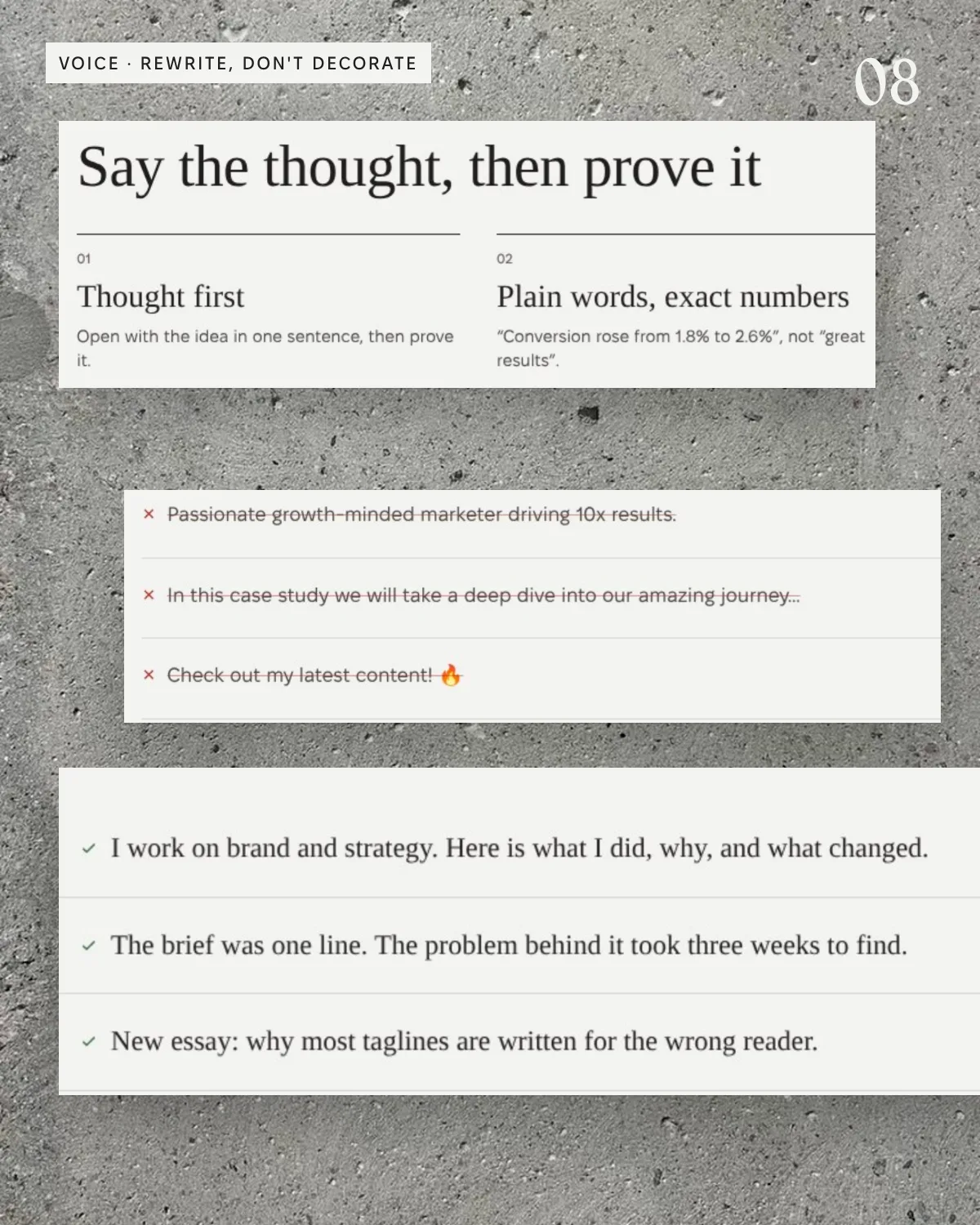
Instead of arguing with my job title, I built a place where you can see how I think: a public archive of my work.
A positioning, a name, a visual identity and a website system, written down in a 54-spread brand book.
What came out of it
Brand strategy
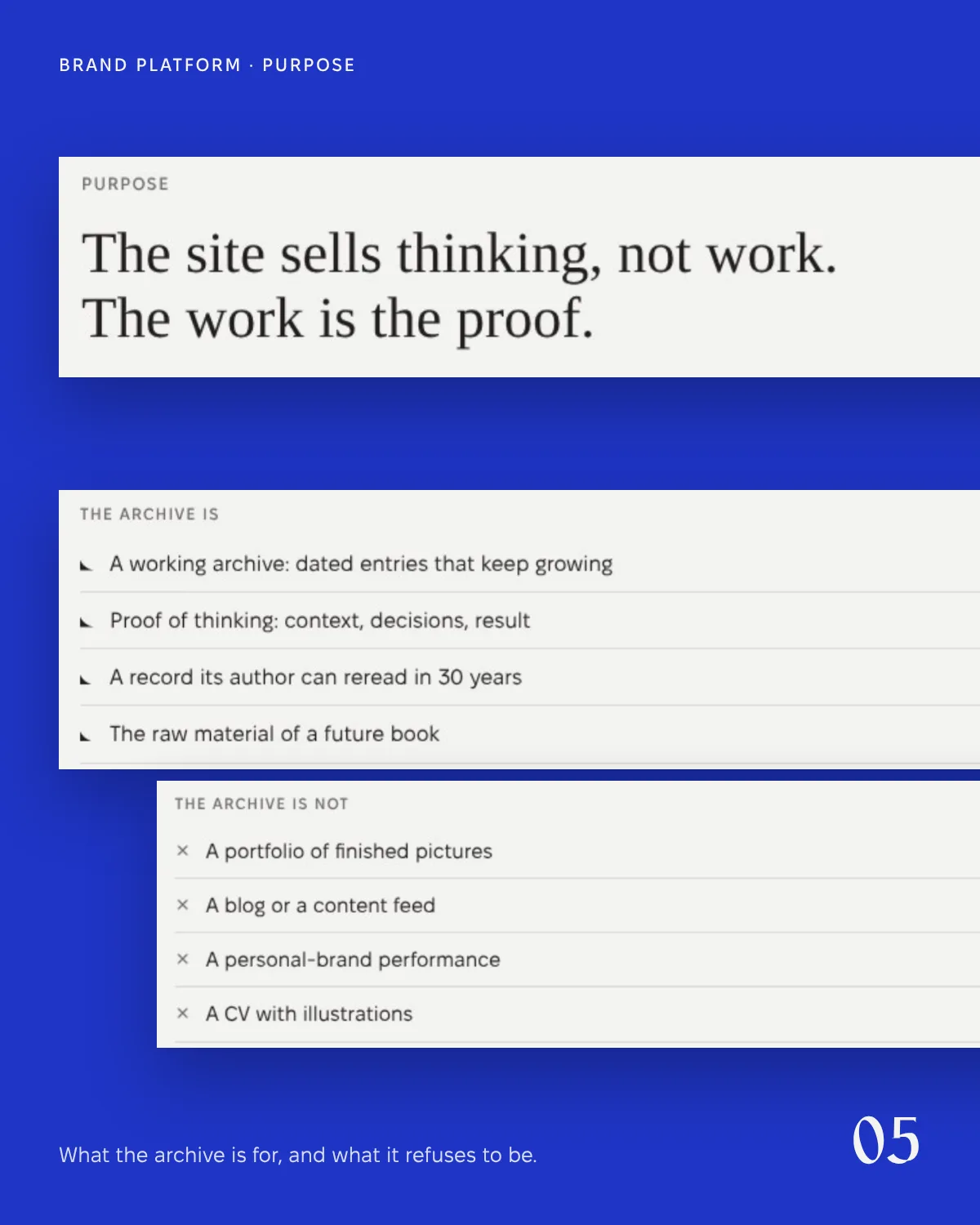
The thinking, written down: what the archive is for, who it speaks to, how it sounds.
Visual brand identity
What you see: the mark, the typeface, the elements and where they live.
This case in four parts
- 01ContextWhere I’m starting fromWho I am, how I ended up in sales, and why my CV tells only half the story.
- 02PreparationThinking it throughThe diagnosis, the ideas I leaned on, and the positioning I landed on.
- 03ExecutionGiving it a faceHow the strategy turned into a mark, a typeface and a visual system.
- 04ResultHow it lives, and what’s nextWhere the archive meets people, how I’ll know it works, and what I learned.
Where I’m starting from
Who I am, how I ended up in sales, and why my CV tells only half the story.
I moved from Kyiv to Lyon when I was 17. I did my bachelor’s in management at IAE Lyon and finished with distinction. Then I spent three years at CEVA Logistics, part of the CMA CGM group, where I went from customer care to junior business developer.
When I got into the M2 in Marketing & Strategy at IAE Paris (Sorbonne), I needed a work-study contract from day one to keep my place. I already had a confirmed offer in sales. Waiting for a marketing one meant risking the master’s, so I took the sales role. It was a decision about safety, and I’d make it again.1
Today I’m an International Business Developer at JOIN Stories, a French B2B SaaS start-up. I genuinely like this part of my story. I learn a lot, and talking to customers every day taught me things no marketing course did: how people actually decide, what they object to, which words make them lean in.
That’s not unusual, by the way. Plenty of good marketers started out selling.
The catch is how the market reads it. When I applied for marketing work-study roles for my second year, I got exactly one interview: trade marketing at L’Oréal. The interviewer told me straight away that what she liked was my sales experience. Even there, I was the sales guy. When I applied for sales roles, more than fifteen companies got back to me.2
So the label sticks. A recruiter sees the job titles first, and mine say sales.
Bohdan Khamazenko
Experience7.4 s
is how long a recruiter’s first look at a CV lasts on average — and job titles get most of the attention.
Ladders, eye-tracking study, 2018
What I took from it:
If your job title doesn’t show how you think, you have to show it yourself.
Thinking it through
The diagnosis, the ideas I leaned on, and the positioning I landed on.
The diagnosis
Here’s the gap as I see it. My CV says sales. What I’m best at is brand and product marketing — and my years in sales are a big part of why. A CV can’t show that, because it shows titles, not thinking.
So I needed another place to prove it: somewhere you can see how I think, what I notice, and how I put things together.
Four ideas I leaned on
01April Dunford, Obviously Awesome
Positioning is context.
Positioning sets the context in which something is judged.
My sales years read very differently as “a marketer who has heard customers say no” than as “a salesperson who wants into marketing”. The site sets that context.
02Herminia Ibarra, Working Identity, HBR Press
You act your way into a new identity.
You don’t think your way into a new career. You get there by trying things and doing new projects.
So every entry in the archive is a small experiment, done in public.
03Austin Kleon, Show Your Work!, 2014
Show the work, not only the result.
Share the process along the way, so people can find you before the finished thing exists.
That’s why my cases show the preparation and the doubts, not just the final slide.
04Jenni Romaniuk, Building Distinctive Brand Assets, OUP, 2018
A brand is memory.
Consistent, distinctive assets help a brand come to mind at the right moment.
A fixed structure for every entry and an identity that doesn’t change are exactly those assets.
Context: Tom Peters’ “The Brand Called You” (Fast Company, 1997) started personal branding as self-promotion. This project goes the other way — a brand built on proof of work, not slogans.
PositioningWorking version
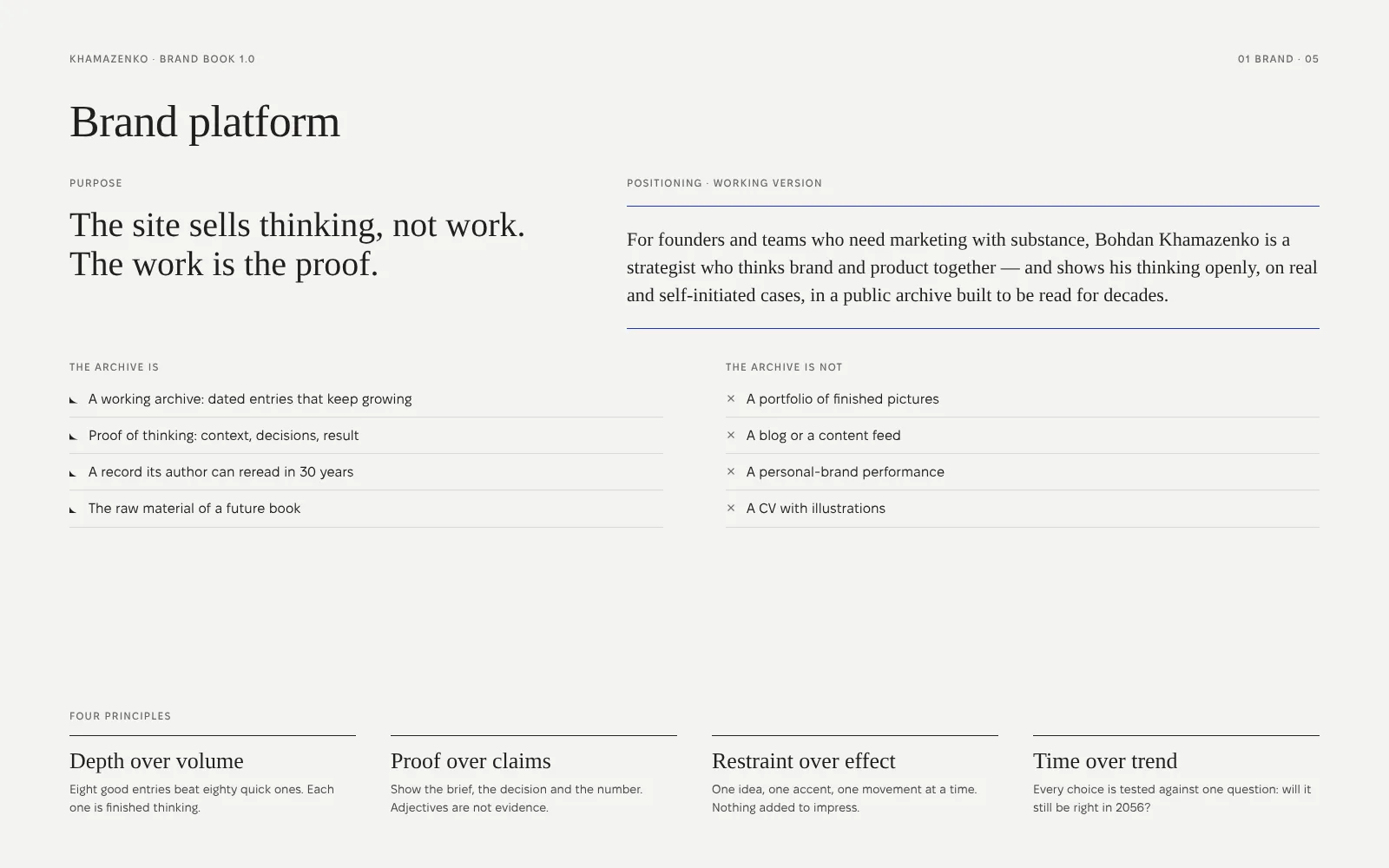
For founders and teams who need marketing with substance, Bohdan Khamazenko is a strategist who thinks brand and product together — and shows his thinking openly, on real and self-initiated cases.
Brand as the strongest skill
Brand strategy and positioning, with product marketing alongside.
Sales as an advantage, not a stain
He knows the customer from the first conversations, not from decks.
Openness
The thinking can be checked, not taken on trust.
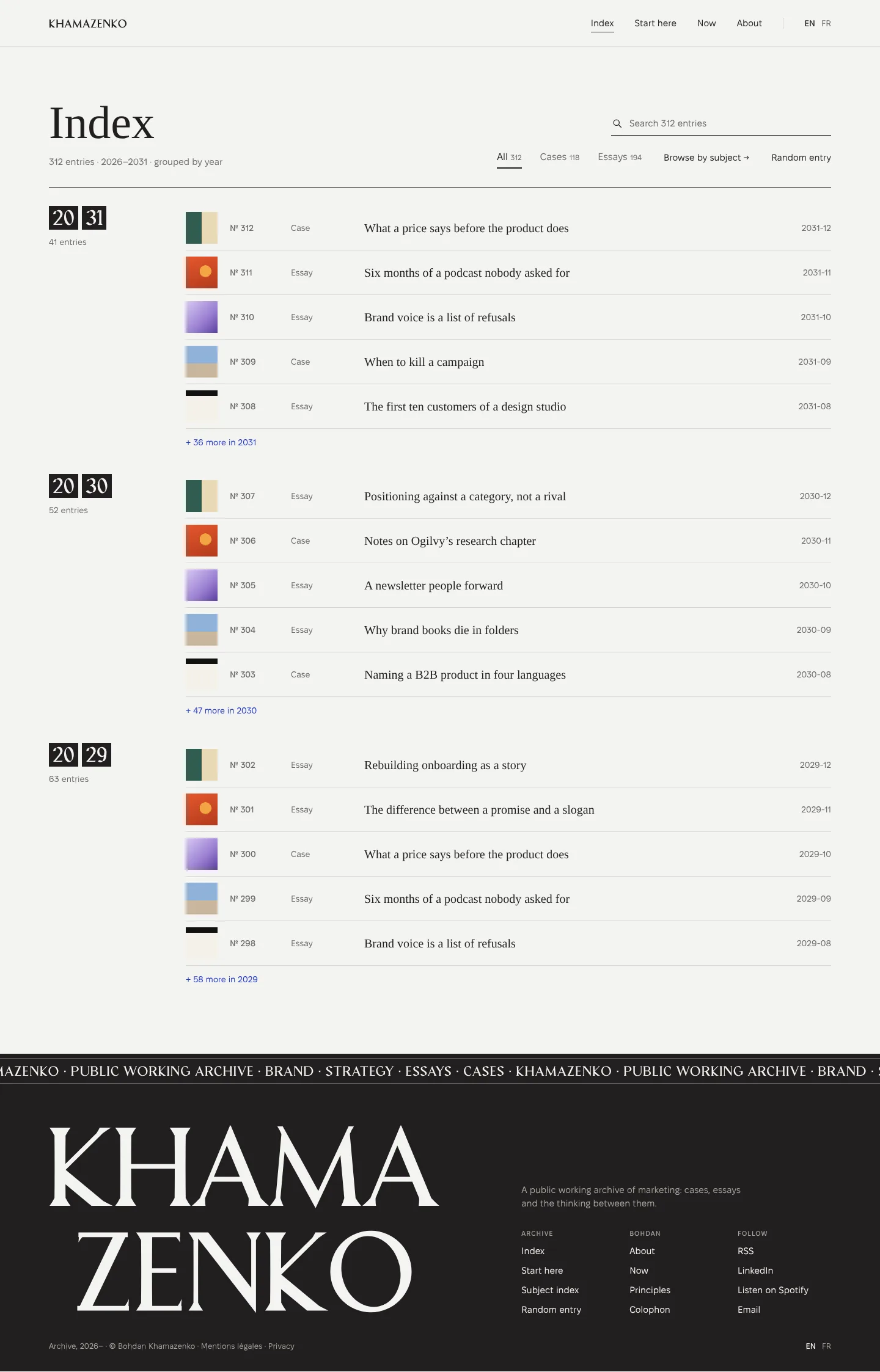
An archive, not a portfolio
That place is an archive, not a portfolio. A portfolio shows your best work and then stops. An archive shows the road, and it keeps growing. I never rewrite old entries; when I change my mind, I write a new one and link back, so you can see how my thinking moves. Thirty years from now, that’s also the material for the book.

Who it’s for
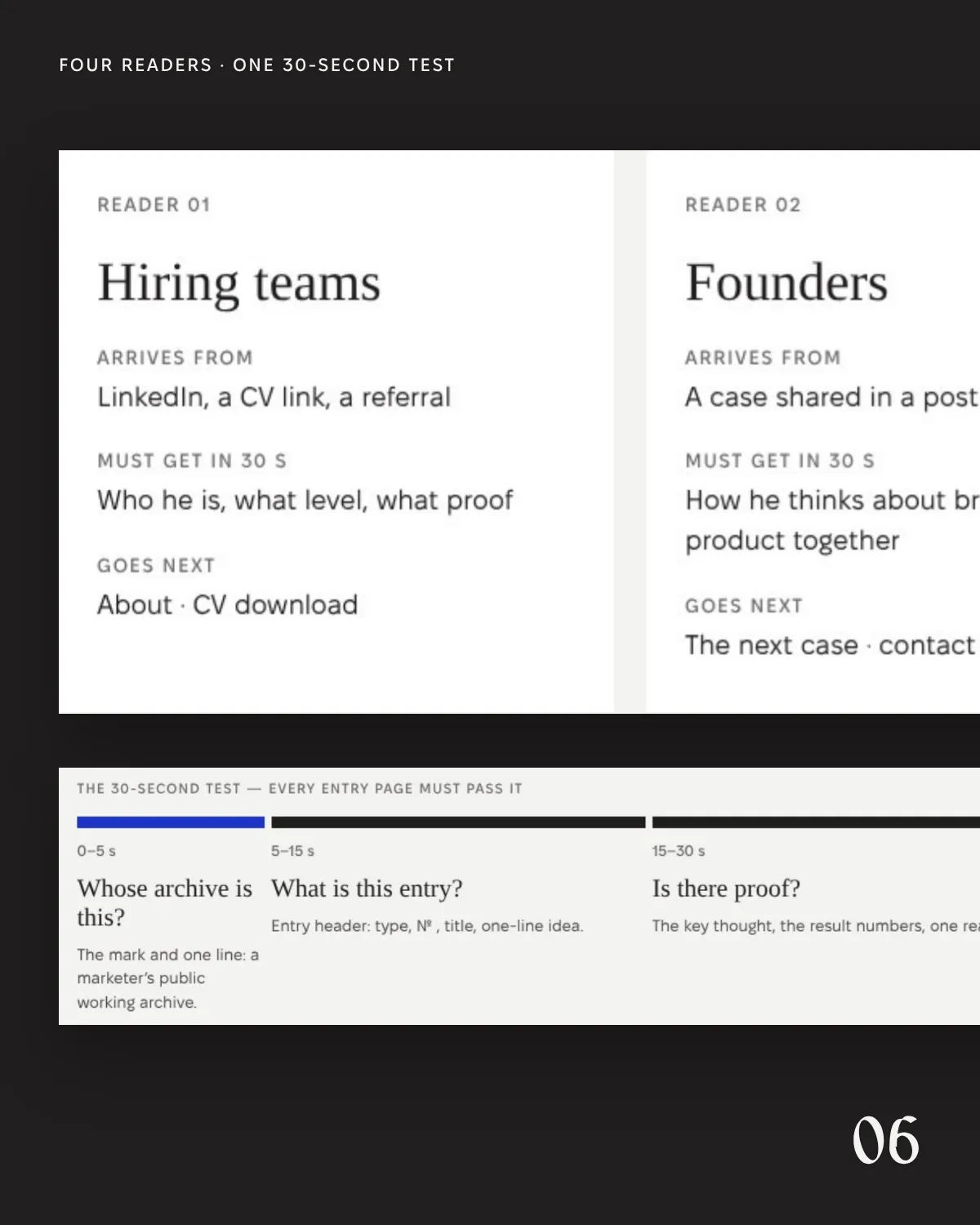
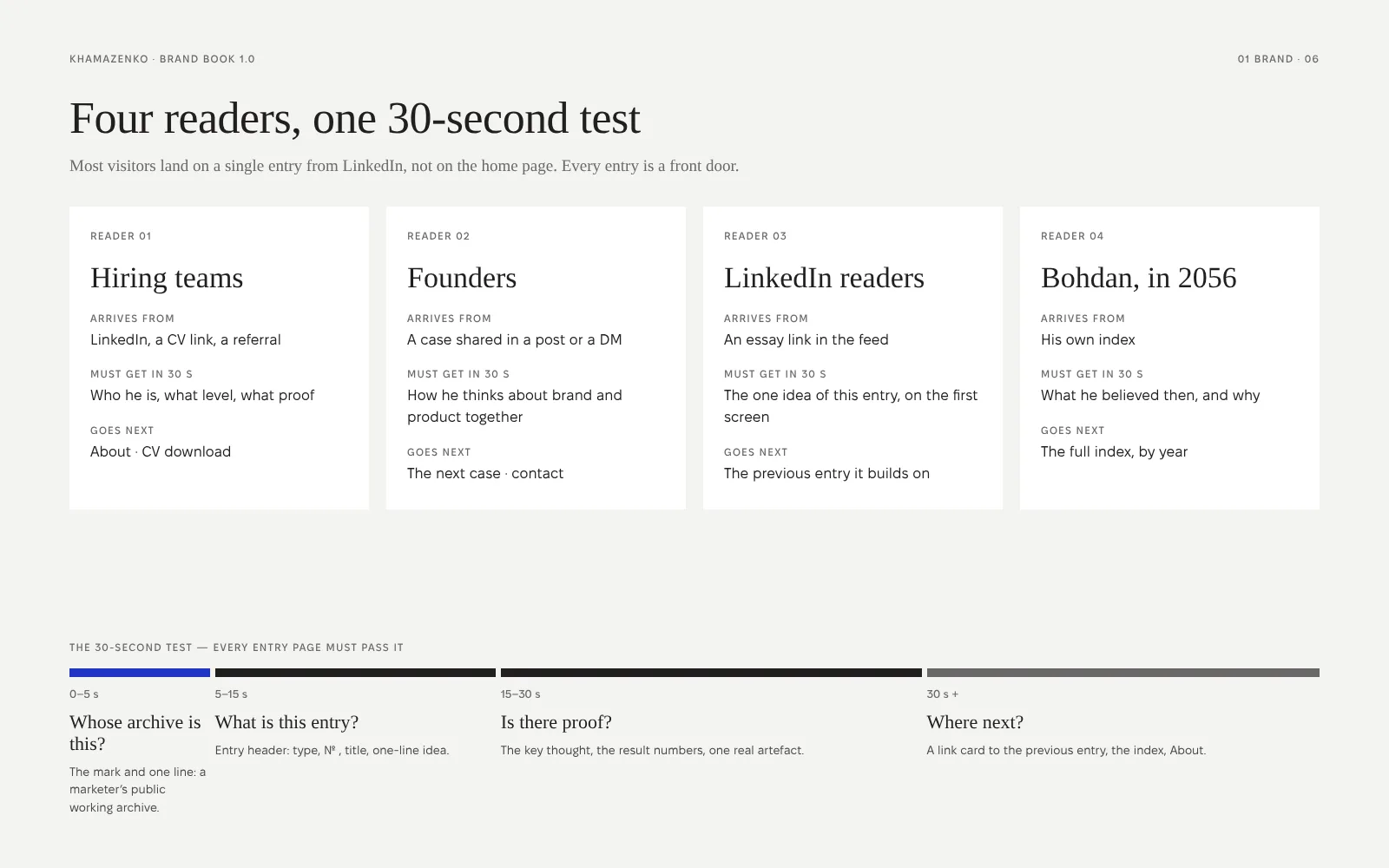
I wrote for four kinds of readers. I want each of them to leave thinking: he has taste, structure and his own point of view. The only reaction I really don’t want is indifference.
| Reader | What they need | What they get |
|---|---|---|
| Hiring teams | To see my level, fast | Taste, structure and real cases in 30 seconds |
| Founders | How I think about a business problem | Cases with the whole line of thought |
| LinkedIn readers | A reason to stay | Essays with one idea each, and a reason to come back |
| Me, in thirty years | A record of how I grew | Dated entries I never rewrite |
Two kinds of entries
There are two kinds of entries, and each has a fixed structure. Self-initiated cases count as much as commissioned ones; they just carry an honest label. Designers and strategists have worked this way for a long time.
- 01Context
- 02Preparation
- 03Execution
- 04Thinking
- 05Result
- 06Conclusions
Case · Commissioned
A real client or employer.
Case · Self-initiated
A real company, rethought by him; the expected result and how it would be measured.
Essay
One idea, 300–500 words, with photos and artefacts.


Why fixed? So you don’t have to relearn every page. And because repetition is what makes something recognisable — see idea 04 above.
Decisions, and why I made them
01The name is just my surname
Ogilvy, Bernbach — the person is the brand. I added nothing. “Archive” says what the site is; it isn’t part of the name.
02Timeless over trends
The site has to look right in ten, twenty, thirty years. So: no fashionable effects — a mark built like a Roman inscription.
03Nothing that doesn’t mean something
Every element has one job. I hold the text to the same rule as the letters.
04Mobile first
Most people will reach me from a LinkedIn link, on a phone. StatCounter had mobile at about half of global web traffic in June 2026; for a site fed by social links I expect more [hypothesis: around 80%].

05Two languages, EN and FR
The job market is France; the ambition is Europe. Every page has both, at its own address.
EN · /en/archive/001An archive proves you can think.
FR · /fr/archive/001Une archive prouve que vous savez penser.
06Content in plain text files
I don’t write code. With plain files in GitHub, any AI assistant can add an entry from the template, and the site outlives whatever tool I use today.
---
number: 001
type: case
label: self-initiated
title_en: …
title_fr: …
date: 2026-11
continues: 002
---07No timelines, no charts
The dates on the entries are enough to show how the thinking evolves.
08A playlist called KHAMAZENKO
What someone listens to tells you a lot about them. It’s the quiet, human layer of the brand.
Giving it a face
How the strategy turned into a mark, a typeface and a visual system.
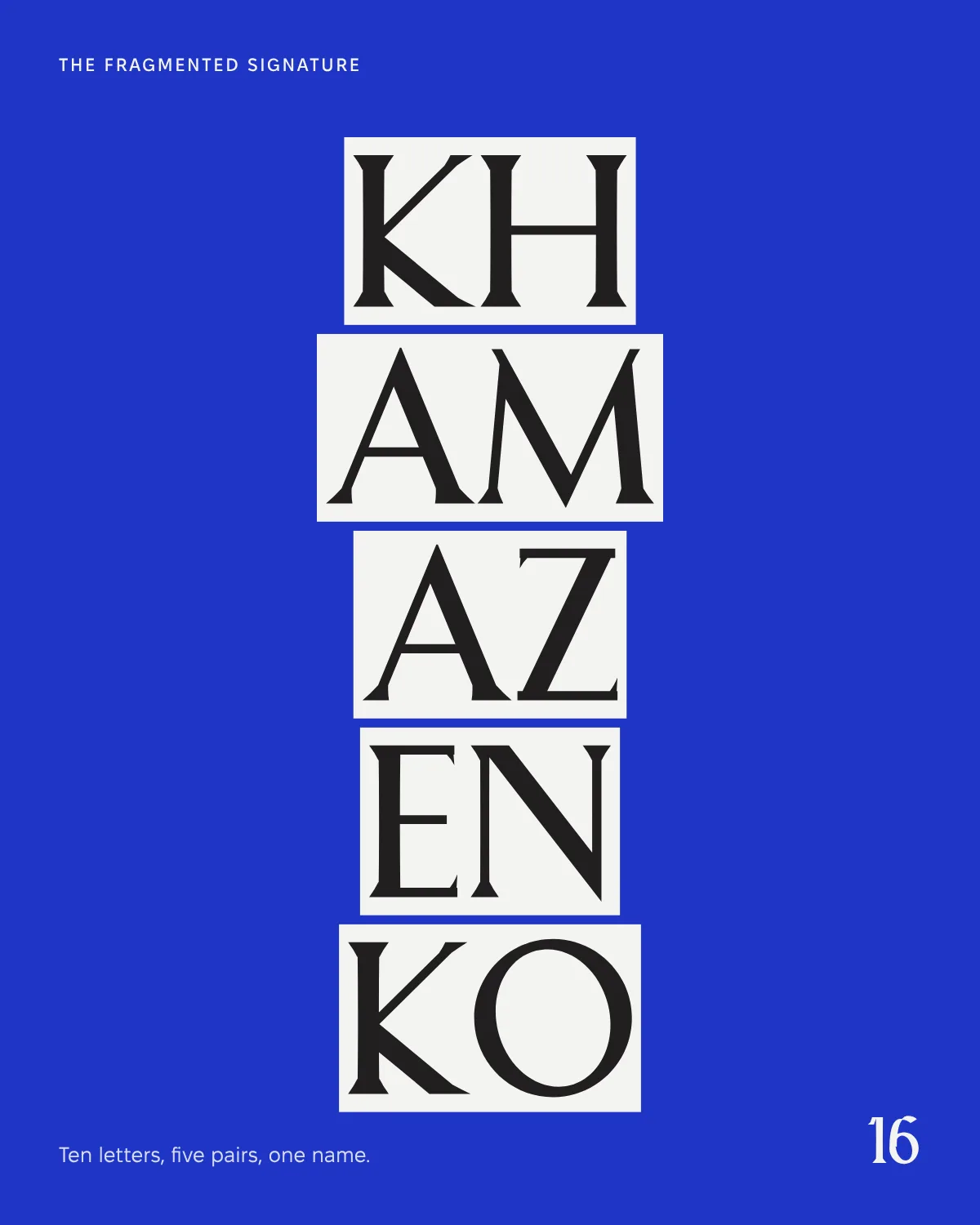
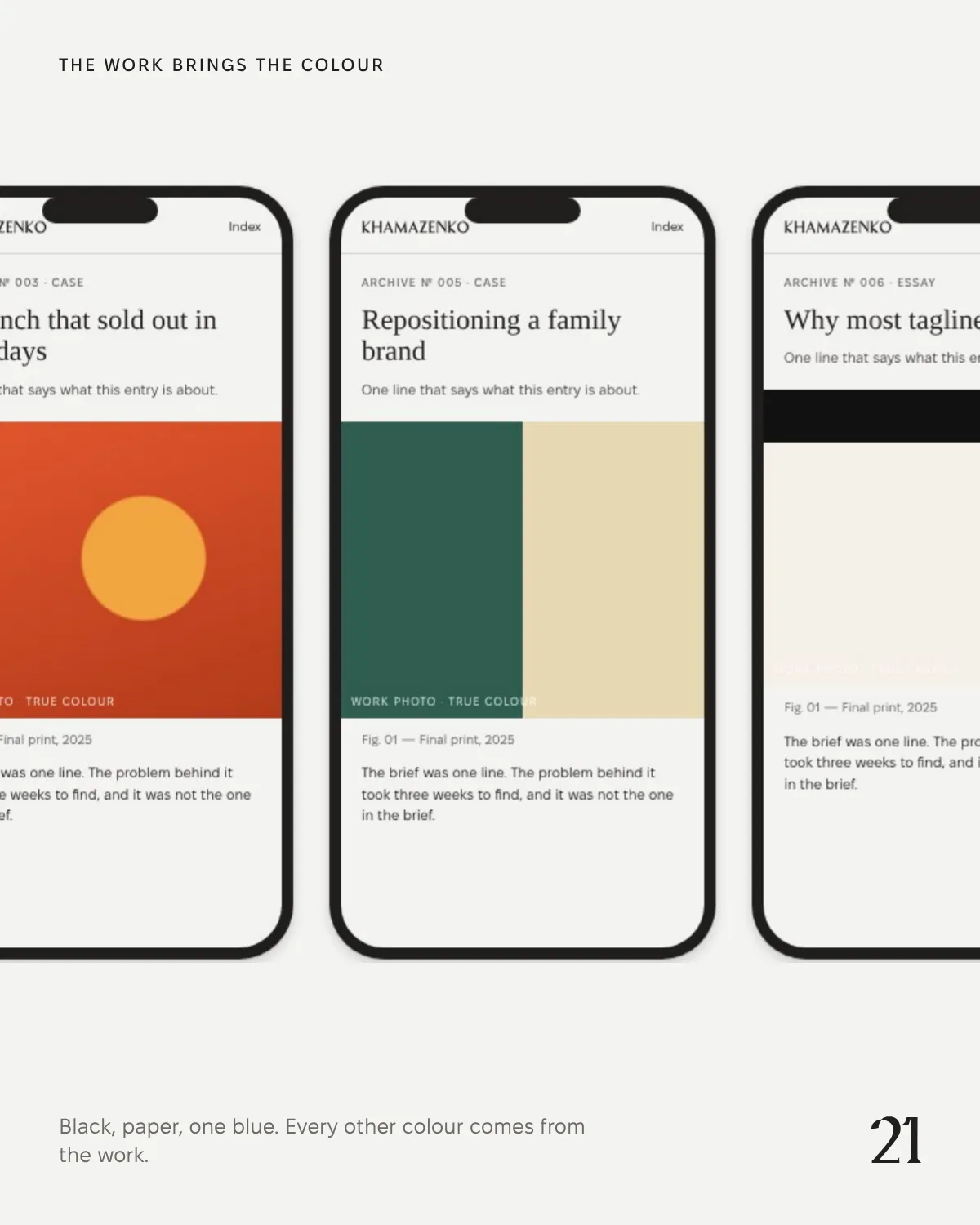
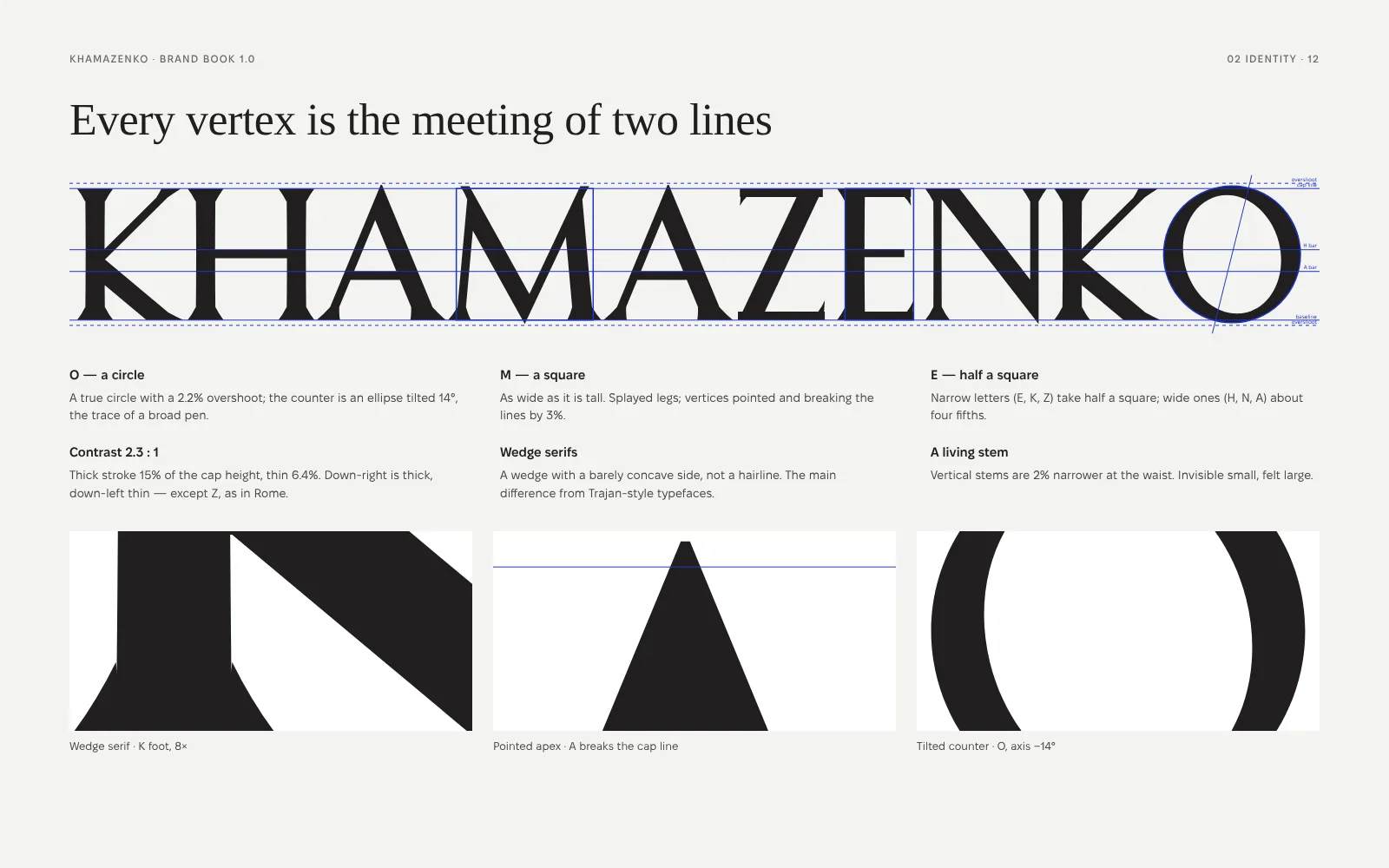
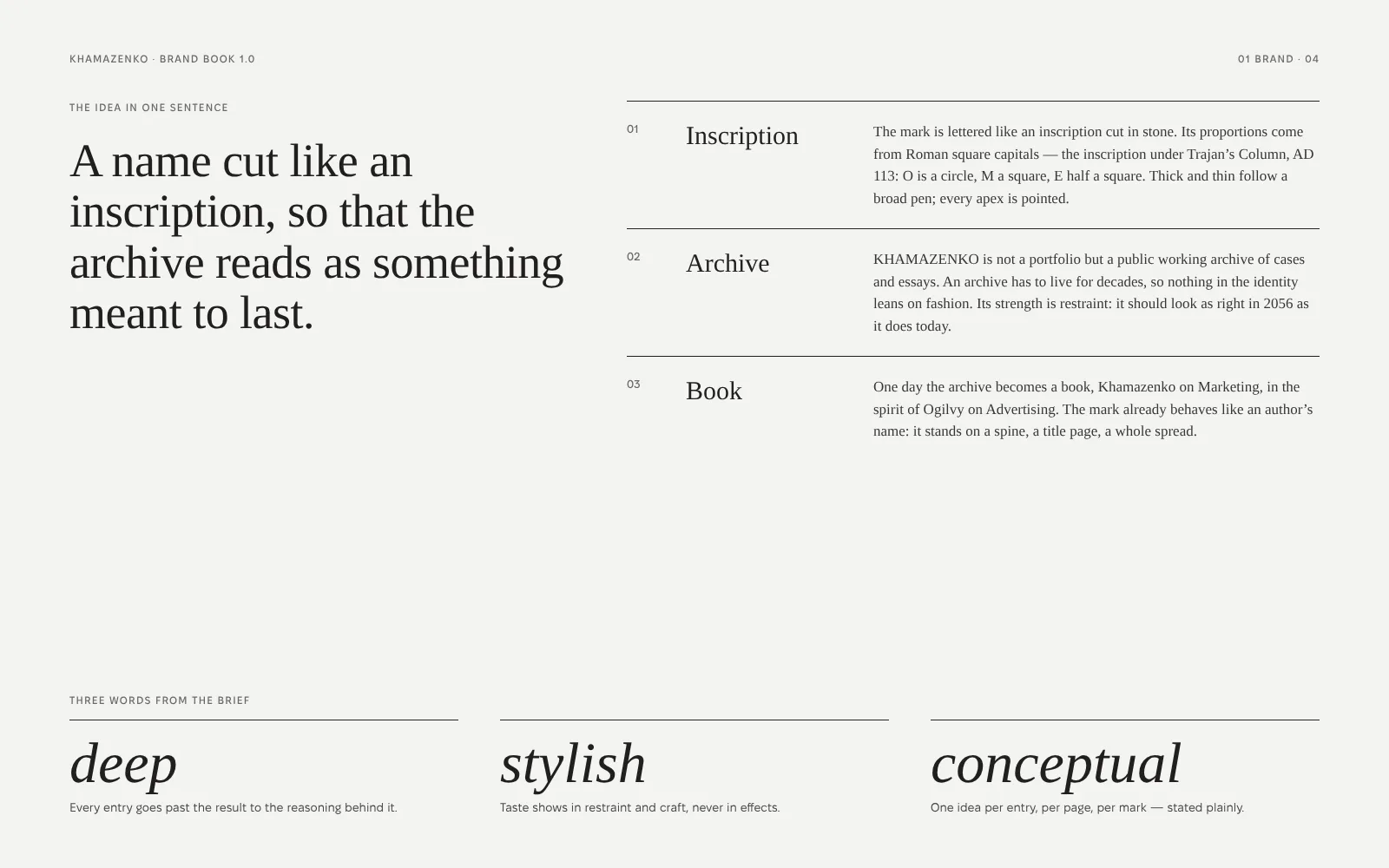
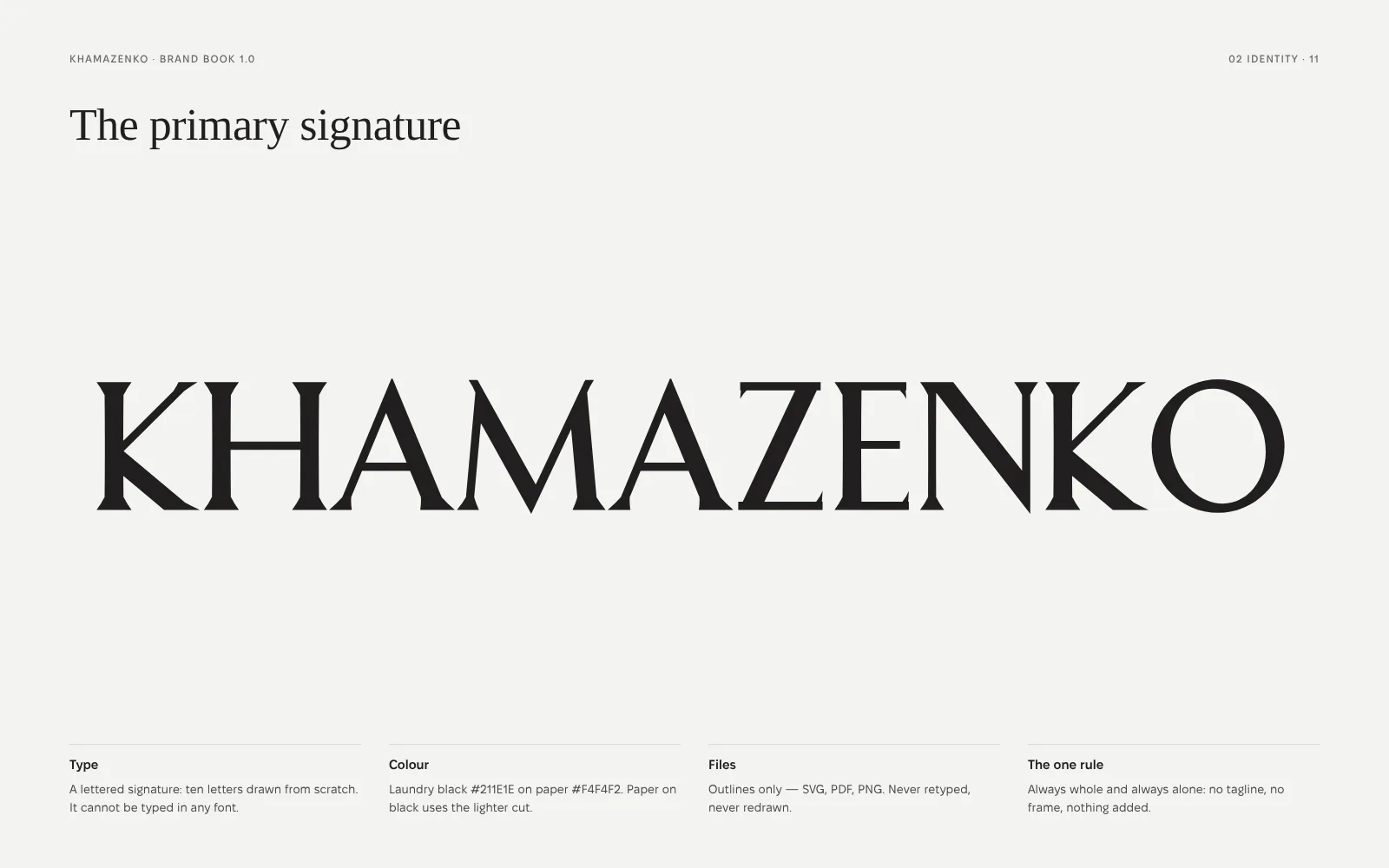
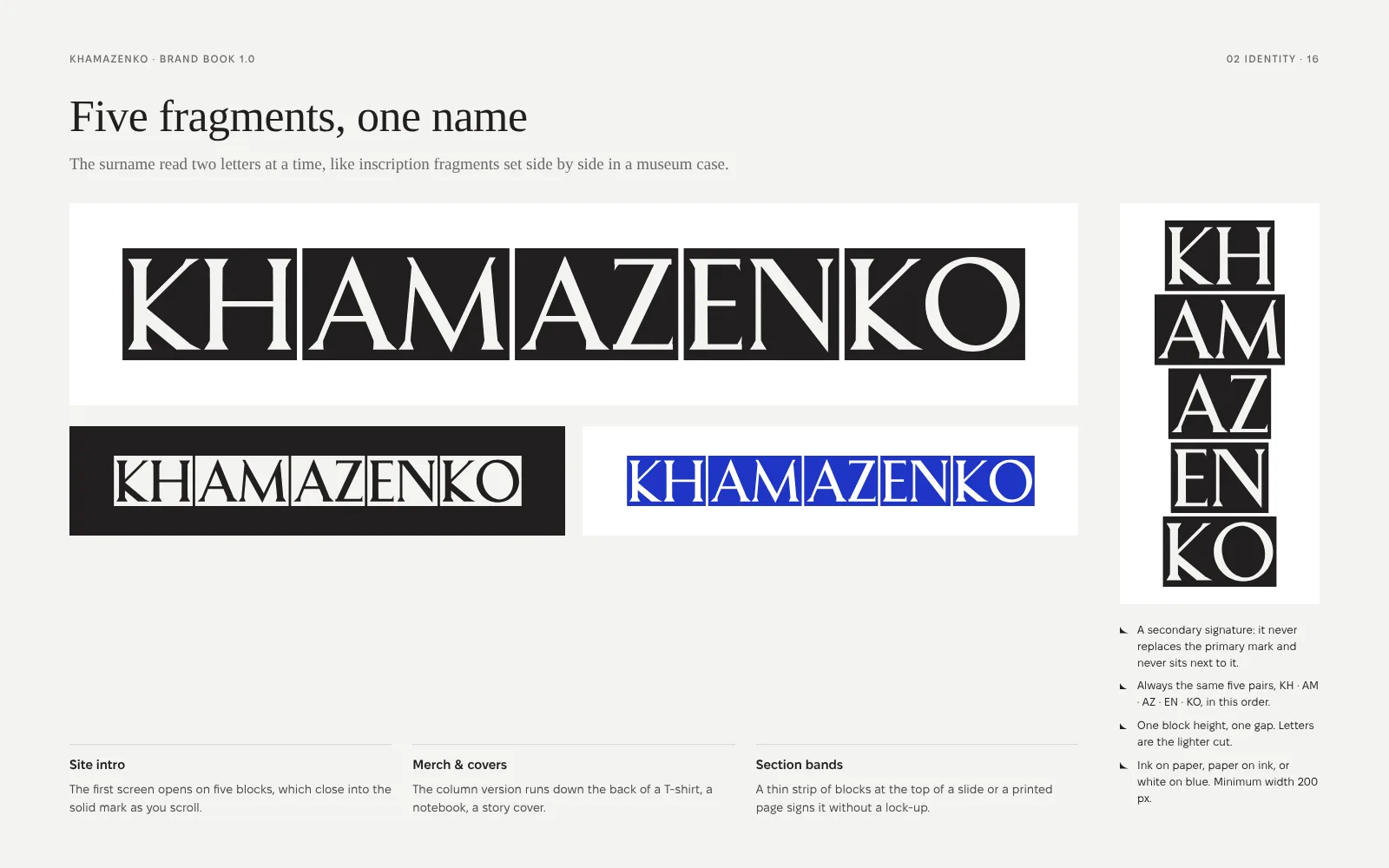
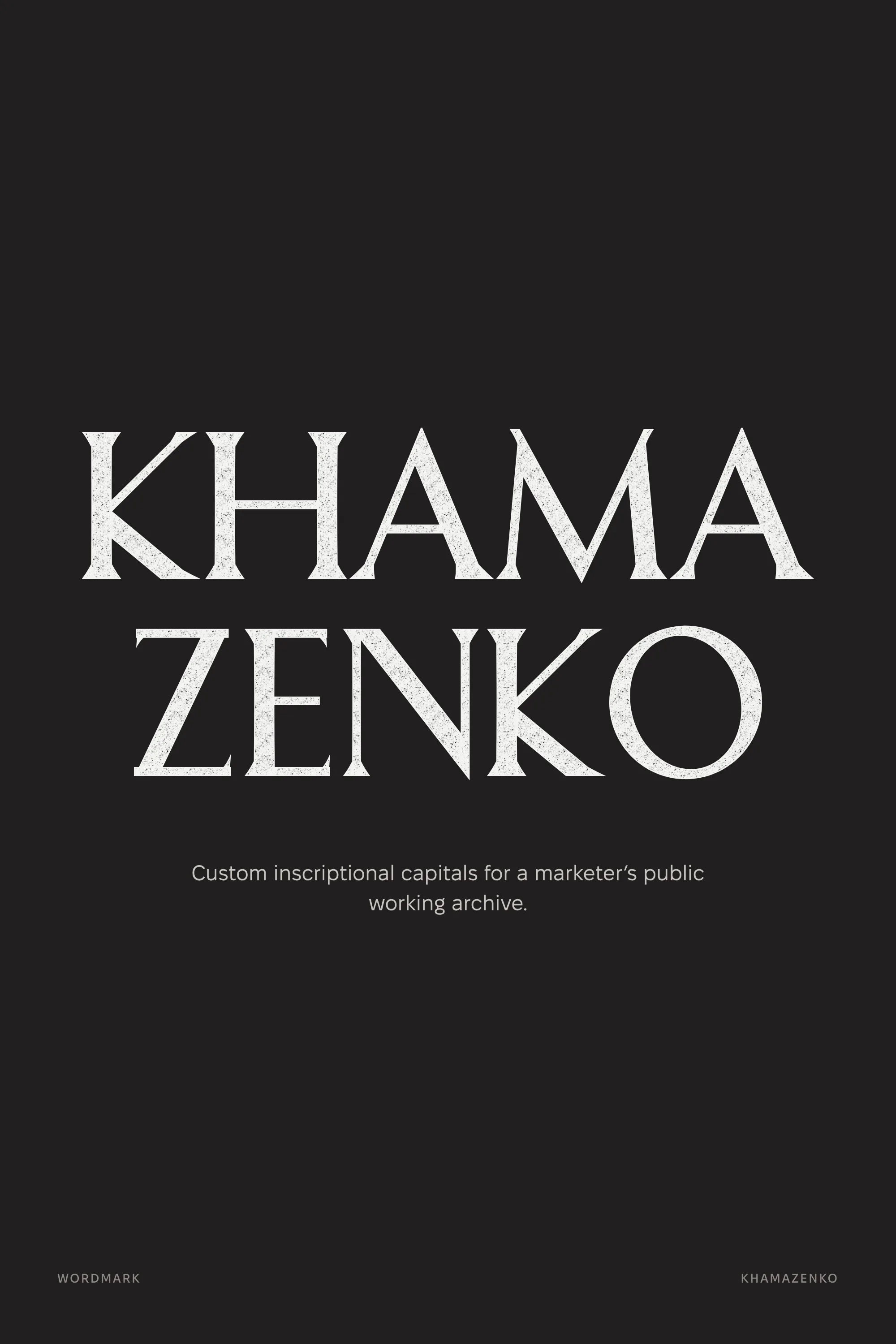
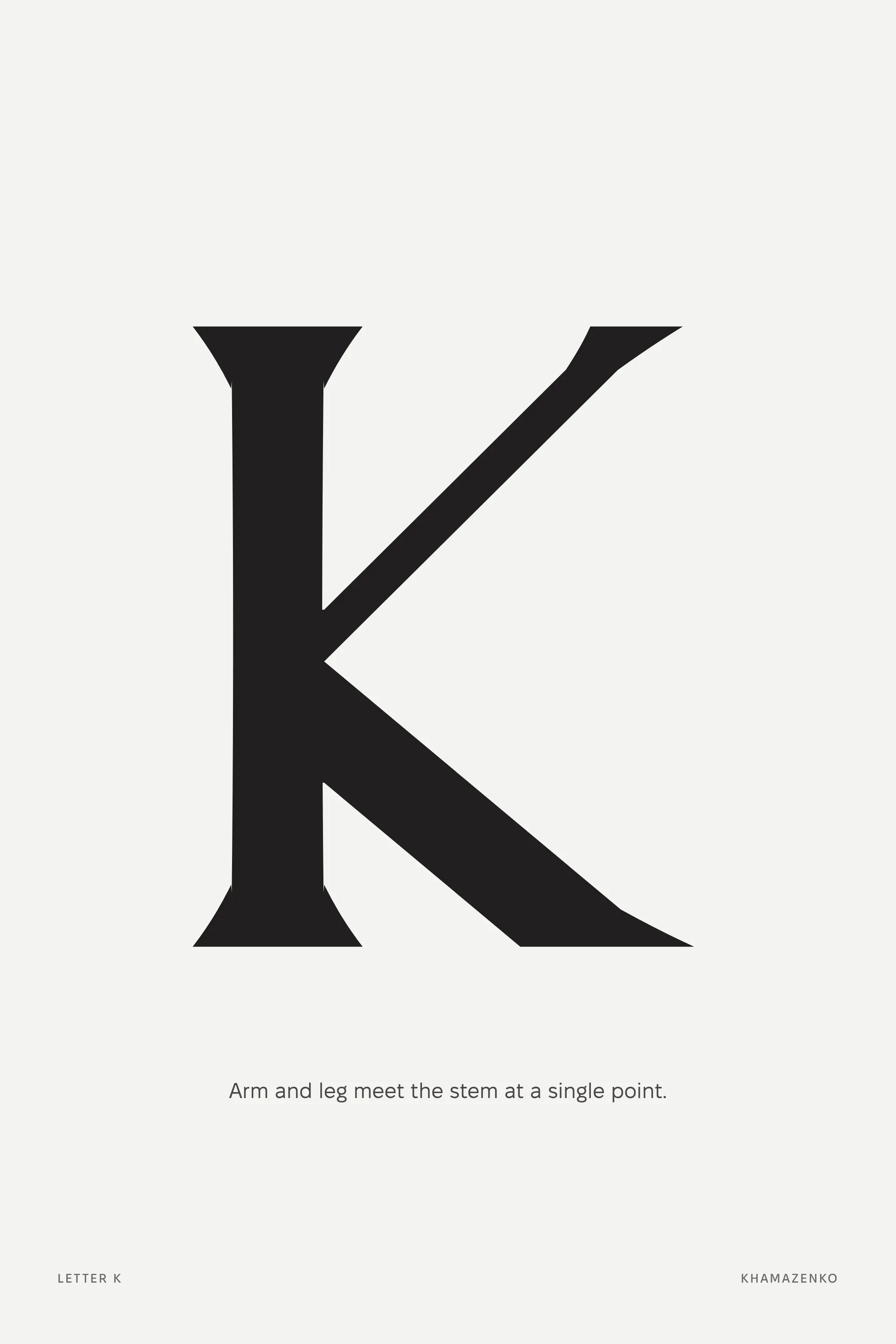
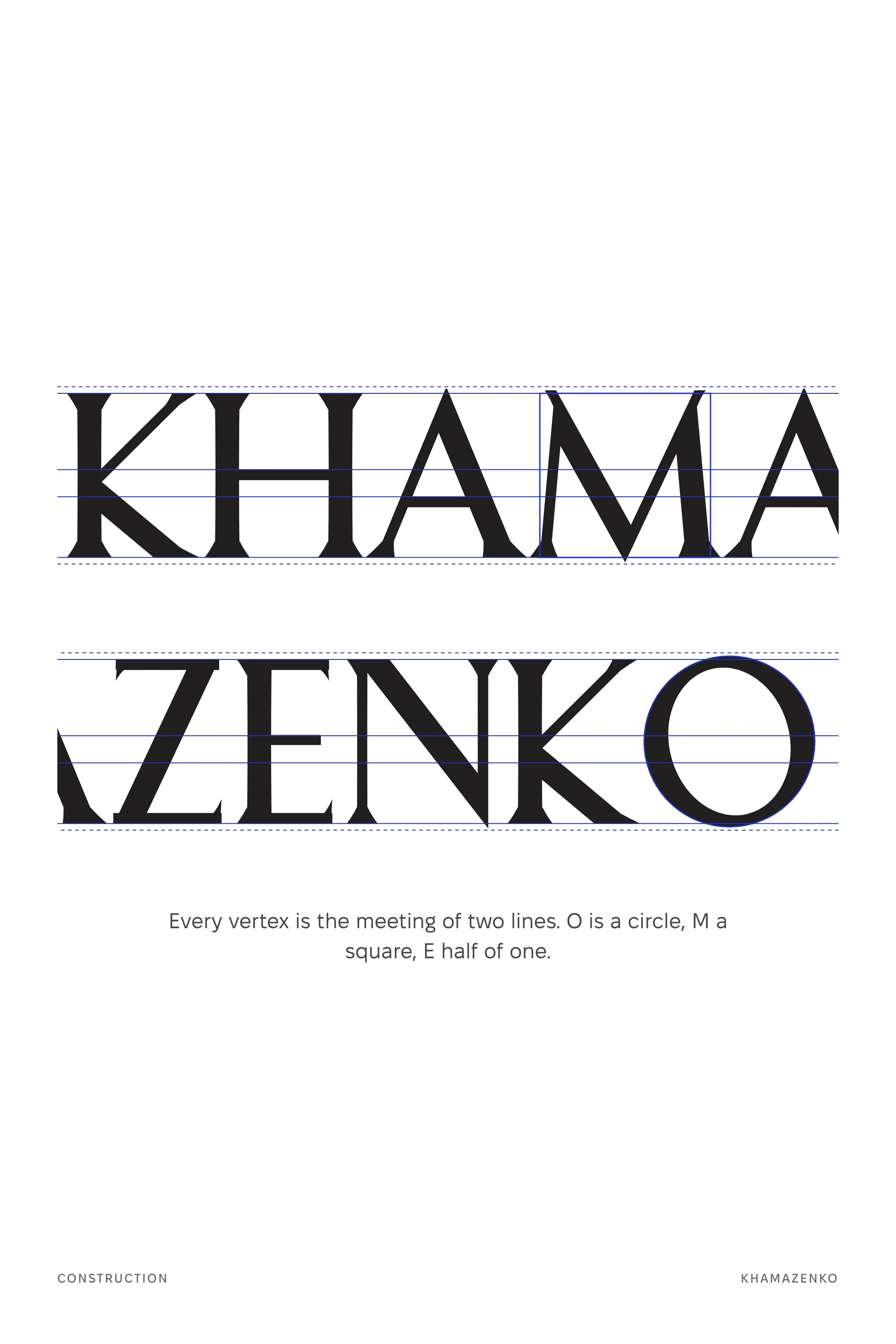
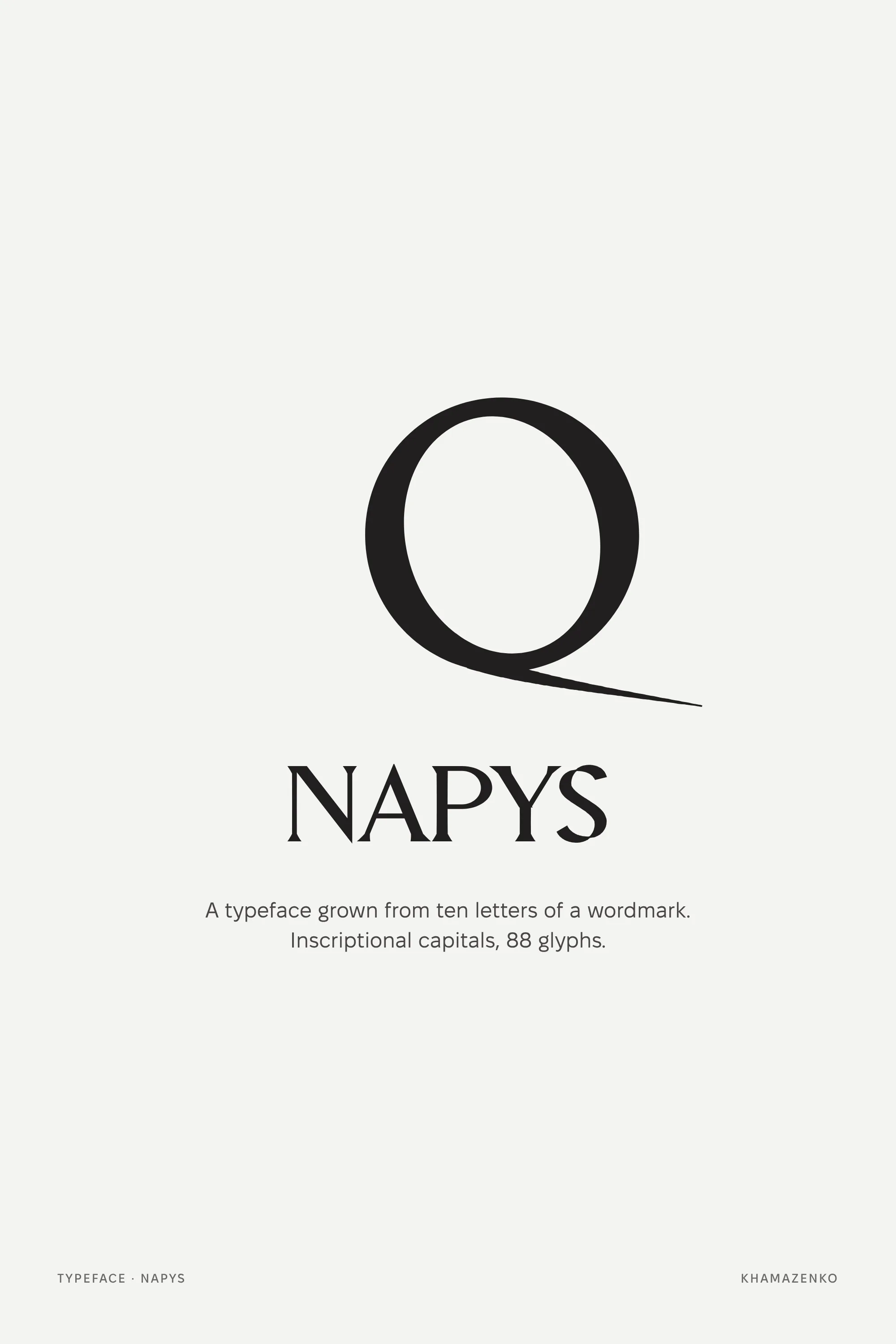
Then I had to make all of that visible. I didn’t want a logo that tries to be clever. I wanted a name that looks like it was cut in stone and meant to stay there: Roman inscriptional capitals, drawn from scratch, one blue, and nothing added.
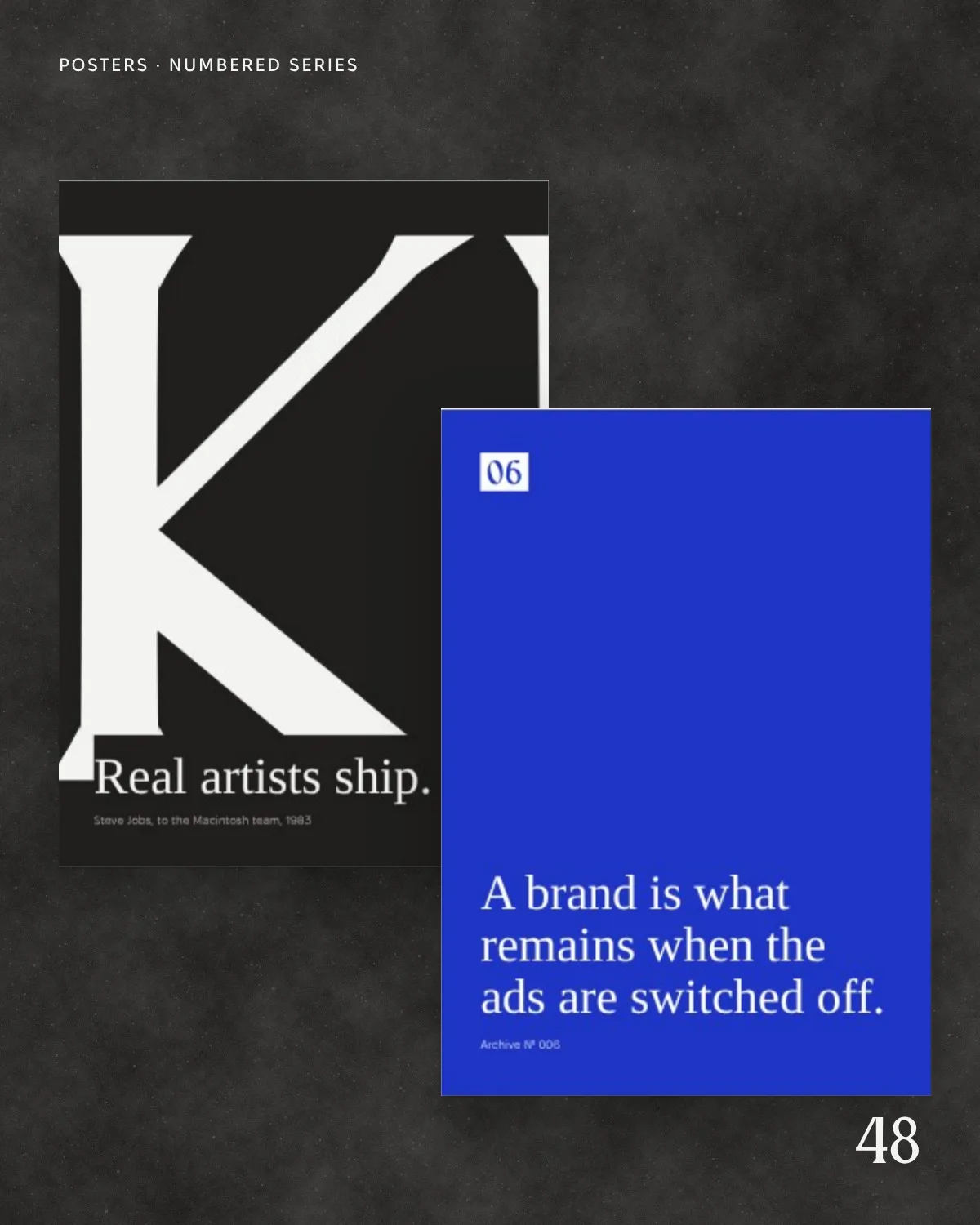
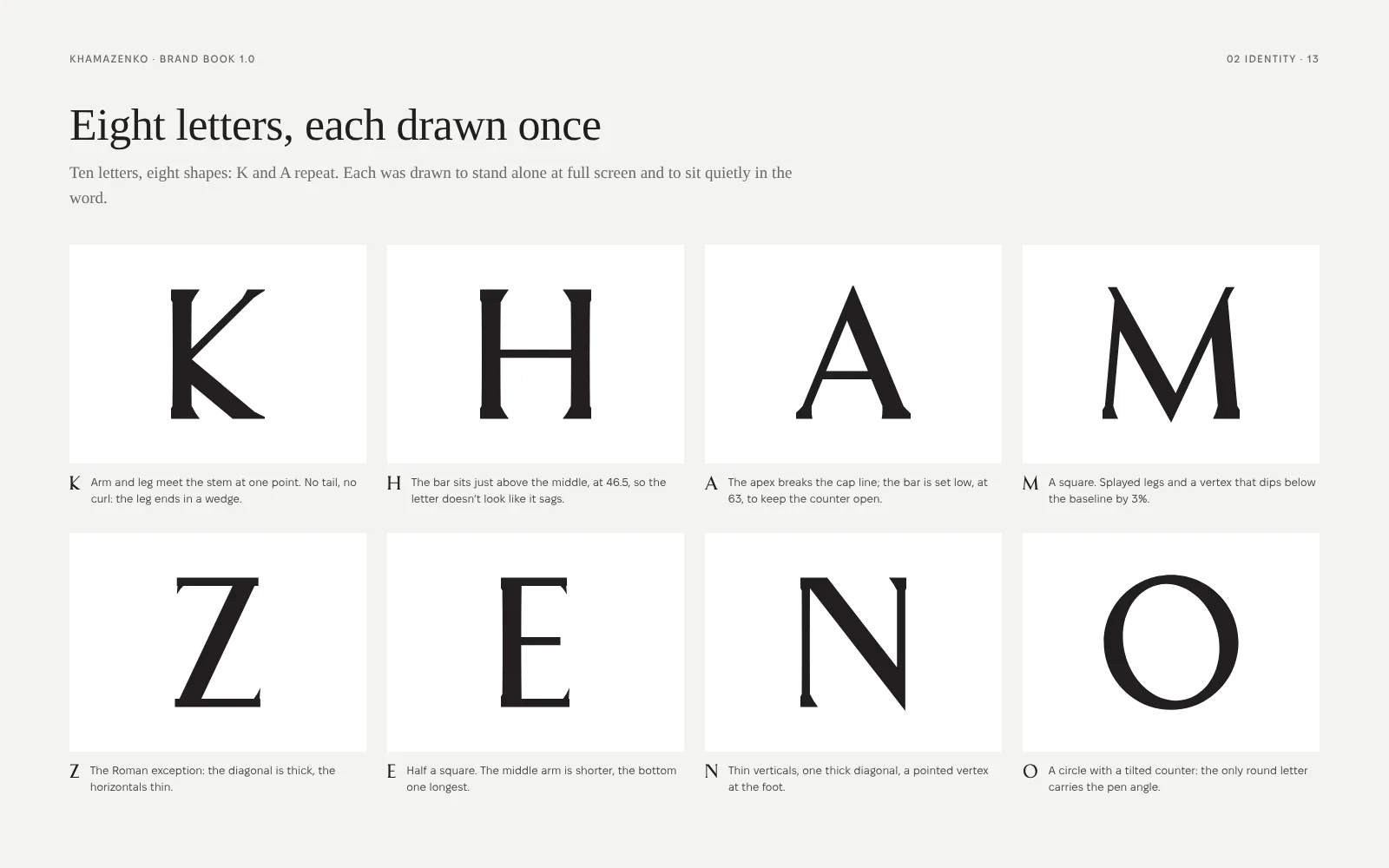
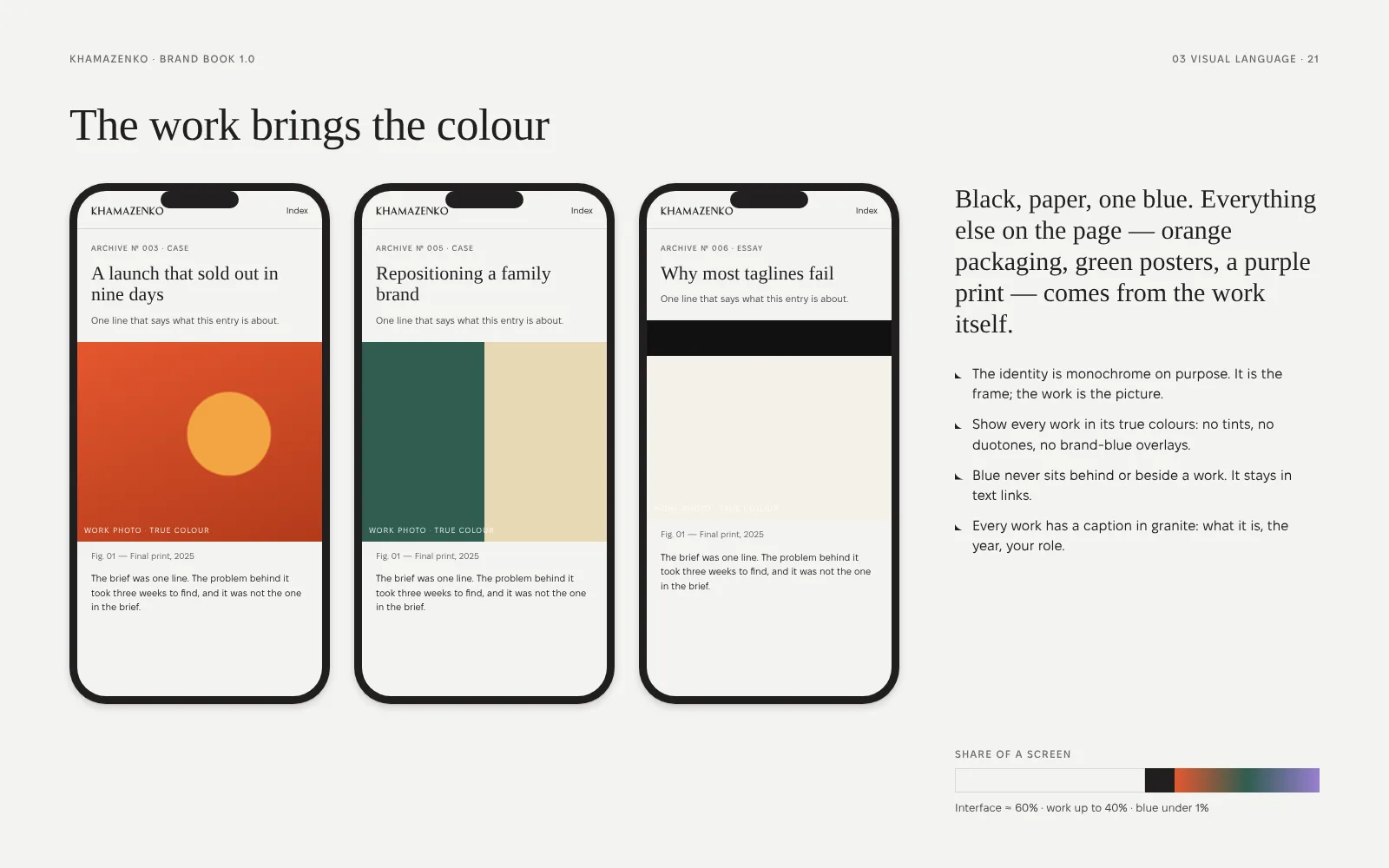
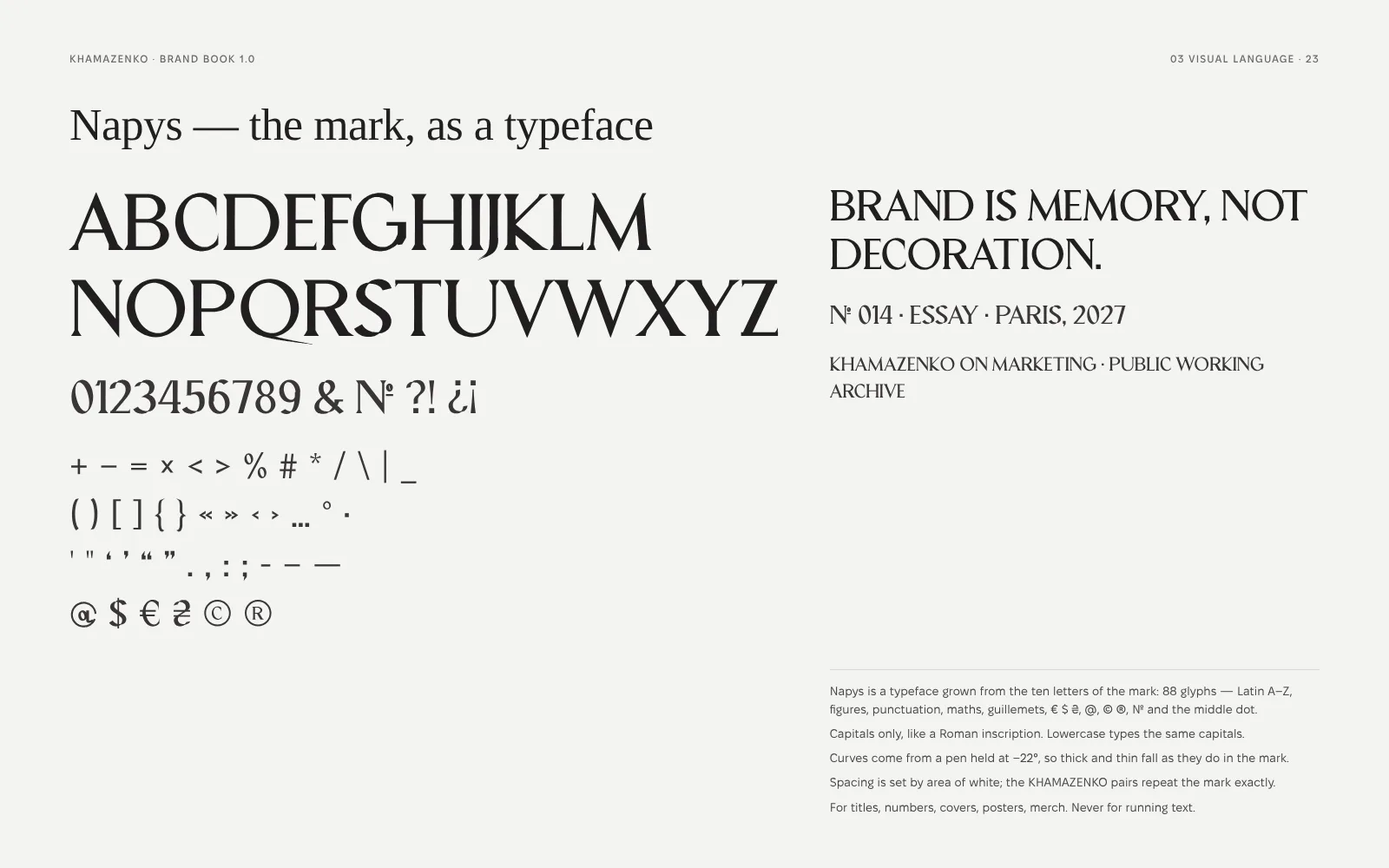
The ten letters of my surname became a whole system: a typeface I called Napys, six elements, eight materials, a grid and a set of rules.
Brand is memory,
not decoration.
- Laundry black
- Paper
- Knight blue
- Granite
 Stone
 Paper
 Specks
 Riso
The brand book
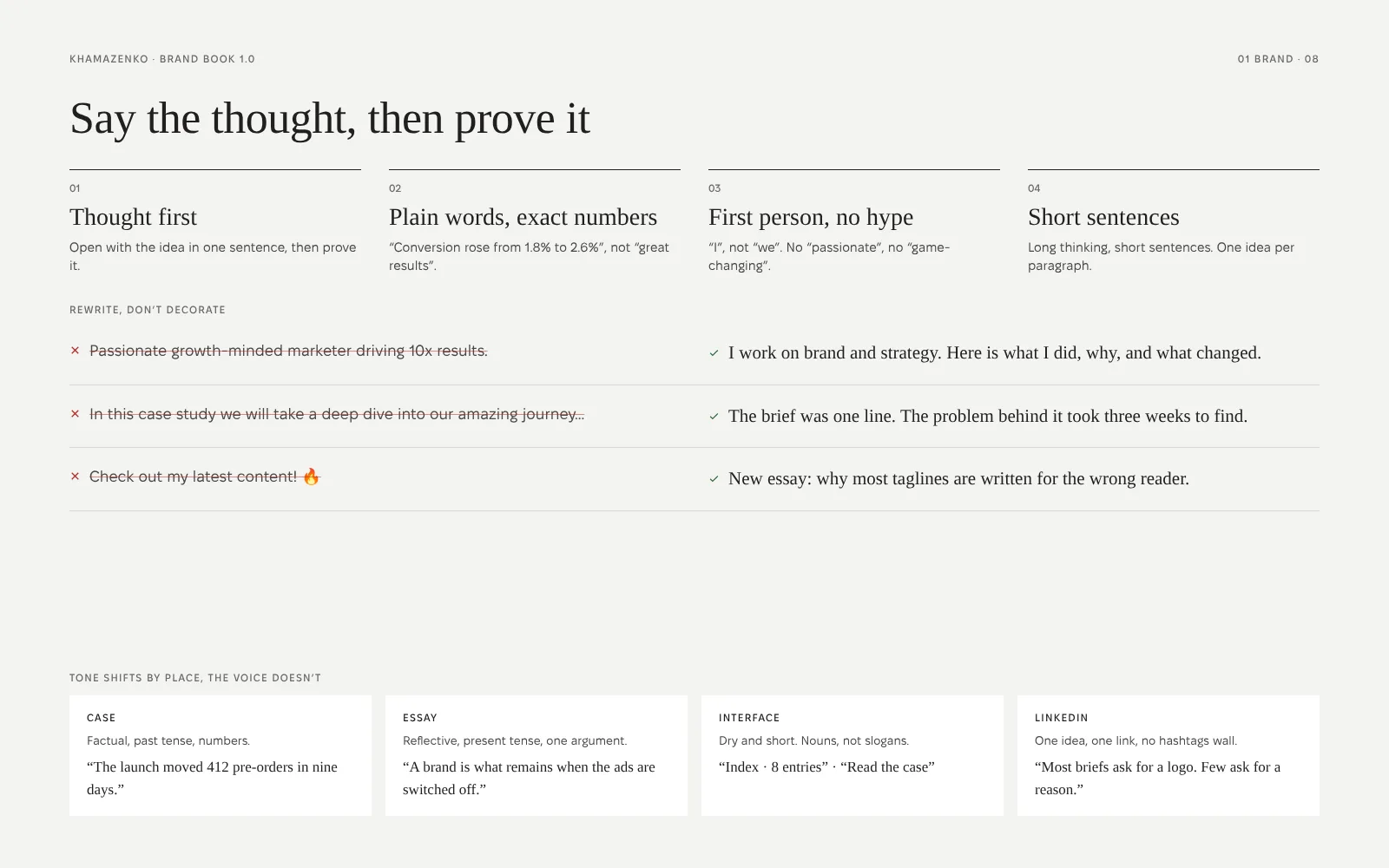
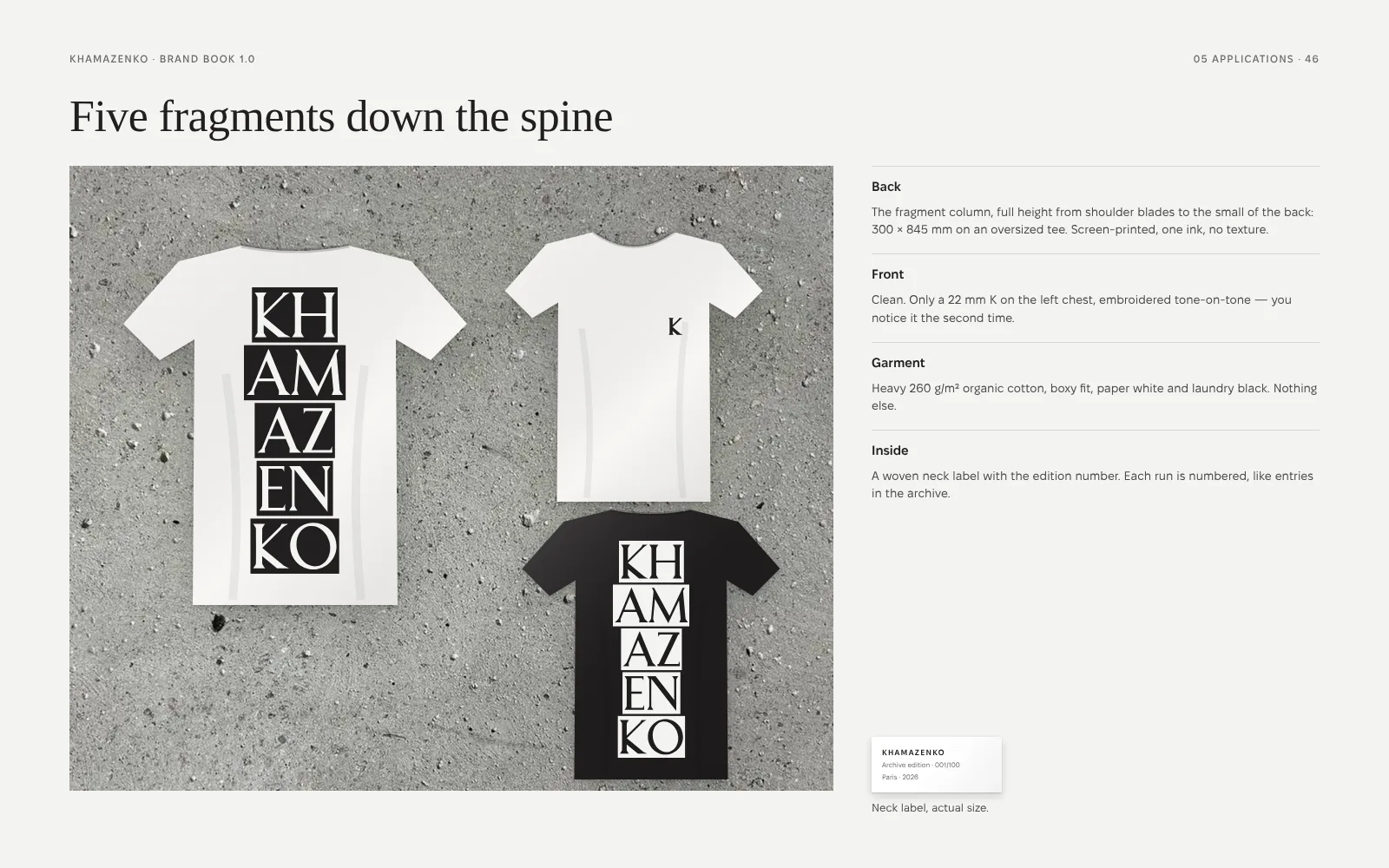
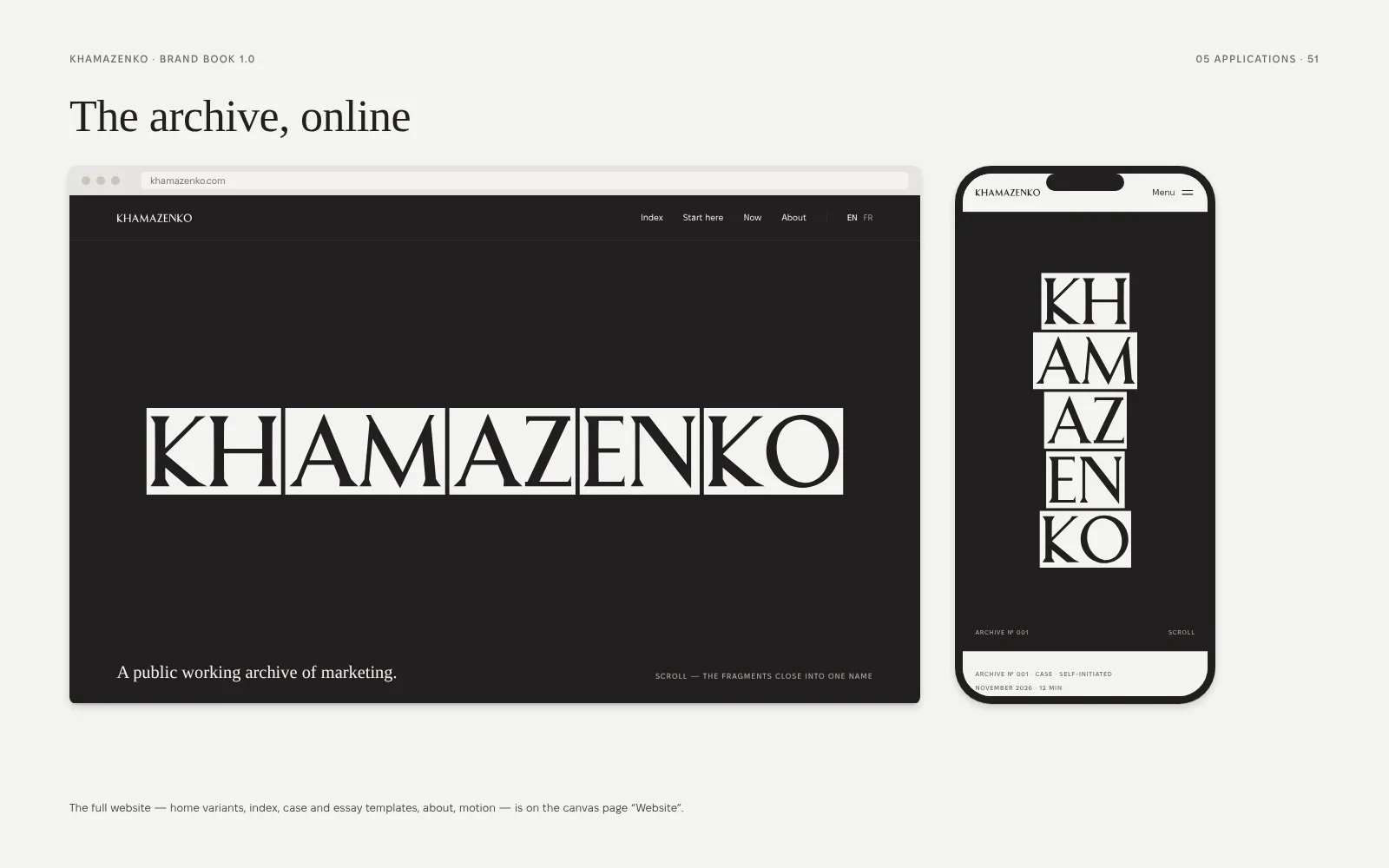
54 spreads, from the idea to the merch. Here are the first twelve.54 spreads. Swipe through the first twelve.
01 / 13
The idea
Swipe, drag or use ← →
The series
18 pins for Pinterest and Behance


How it lives, and what’s next
Where the archive meets people, how I’ll know it works, and what I learned.
How it lives
Every case or essay also goes out as a LinkedIn post that links to the full entry. The site is where everything is kept; the posts are how people find their way in.
Which means most people won’t land on my home page. They’ll land on one entry. So every entry has to work as a front door on its own.
 Bohdan KhamazenkoBrand & product marketing · Paris
The first entry in my archive is the archive itself.

Which means most people won’t land on my home page. They’ll land on one entry. So every entry has to work as a front door on its own.
Why it’s a long game
Most personal branding is about getting noticed. I want to be trusted, and trust takes longer than a launch week.
Binet and Field showed that long-term brand building does most of the work, while short-term activation turns it into results. For me, the archive is the long game. Applications and messages are the activation. Each works worse without the other.3
Where it stands
What exists today is the strategy, the identity and the design of the whole system. What it achieves, I’ll measure from launch, and I’ll write about it here as new entries.
How I’ll know it worksWorking version
- Main goal
- A permanent role in marketing — brand and product — at the start of 2027.
- Along the way
- Interview invitations · messages from founders and recruiters · clicks from LinkedIn to the site · returning readers · how many people finish an entry.
- What people say
- After a visit, do people use the words deep, stylish or conceptual on their own?
The site isn’t live yet, so these are goals, not results.
What’s next
- 01
Launch in early 2027 with six to eight entries.
- 02
Then a new entry every week.
- 03
Start here, Now and the colophon at launch; the subject index and principles once there’s enough to index.
- 04
Keep writing, and see if a book grows out of it.
- 05
Longer term: CMO before thirty, or a company of my own.
Three things I learned
- 01
Write down what it must not be before you decide what it should be.
- 02
Check it at 16 pixels before you fall in love with it at 1,600.
- 03
A system is mostly a list of things you’ve decided not to do.
Downloads
Strategy, direction and lettering by me, with Claude (Anthropic) as studio partner.
Sources
- April Dunford, Obviously Awesome — positioning as context.
- Herminia Ibarra, Working Identity, Harvard Business Review Press (updated edition 2023).
- Austin Kleon, Show Your Work!, 2014.
- Jenni Romaniuk, Building Distinctive Brand Assets, Oxford University Press, 2018.
- Les Binet & Peter Field, The Long and the Short of It, IPA, 2013.
- Tom Peters, “The Brand Called You”, Fast Company, August 1997.
- Ladders, eye-tracking study, 2018 — 7.4 seconds on the first look at a CV.
- David Ogilvy, Ogilvy on Advertising, 1983.
- StatCounter Global Stats, mobile share of web traffic, June 2026.
- Wikipedia, “David Ogilvy (businessman)” — AGA cookers and the 1935 sales manual.
- The Unpublished David Ogilvy — Fortune, 1971: “probably the best sales manual ever written”.